

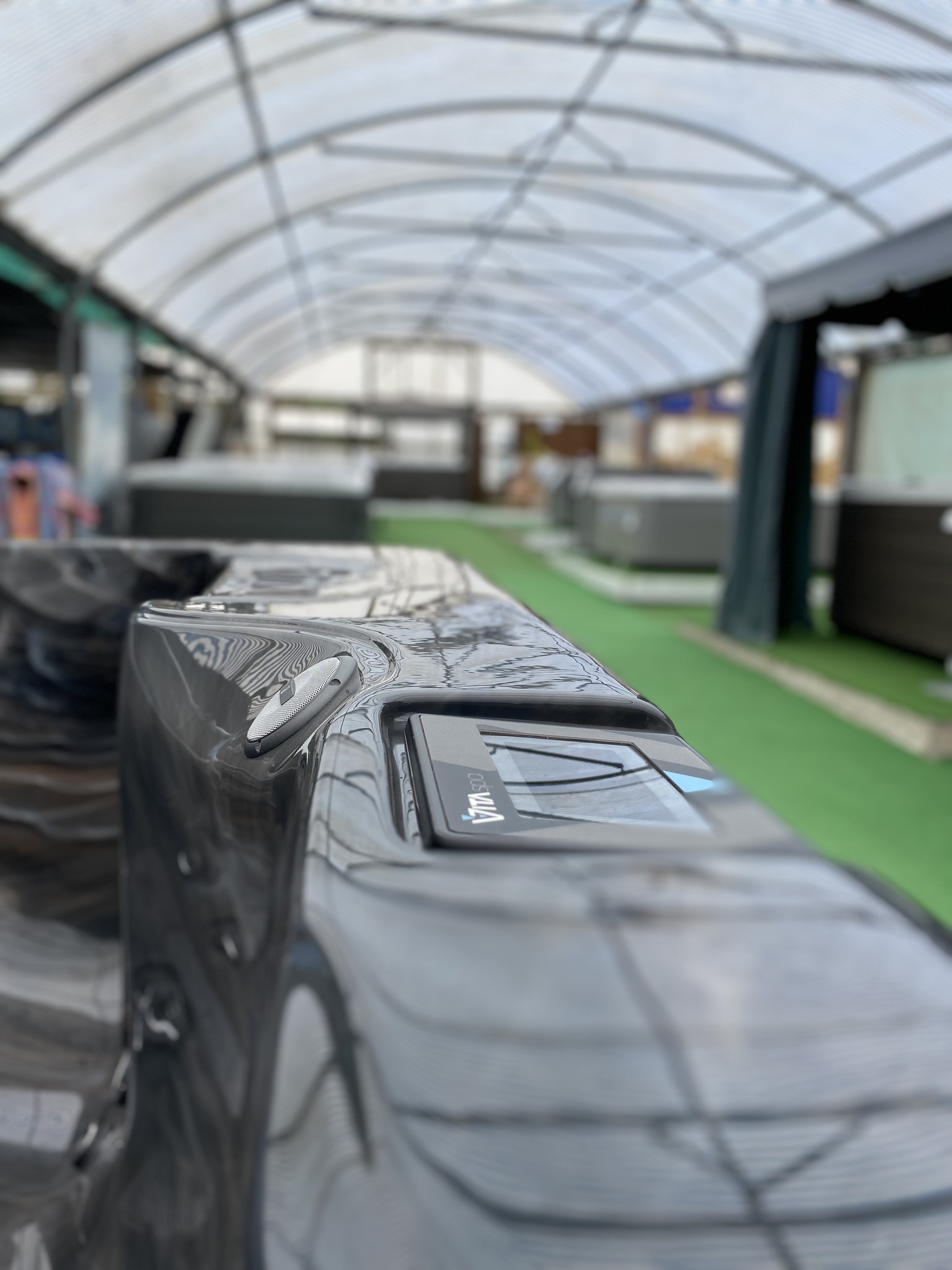
Walk into any hot tub showroom and you will hear about jets. Jet count, jet placement, rotary jets, directional jets. You will hear about pumps, control systems, LED lighting. The cover gets about thirty seconds, usually when someone gestures at it and says “obviously it comes with a lid.”
That lid is responsible for more of your running costs than everything else combined. Get it right and a hot tub costs reasonable money to run. Get it wrong and you are paying to heat the garden.
Where the heat actually goes
A hot tub loses heat in two ways: through the cabinet and floor, and through the surface of the water. The split is not close. Research from the US Department of Energy and independent studies consistently put surface heat loss at over 90% of total heat loss when the cover is off or poorly fitted. Even with a cover on, a degraded or poorly designed one bleeds heat continuously.
The physics is straightforward. Warm water evaporates. Evaporation is an energy-intensive process: it costs roughly 2,260 joules per gram of water to turn liquid water into vapour. A hot tub running at 38 degrees in a cool evening garden is producing a constant stream of water vapour that takes heat with it. The cover’s job is to trap that vapour, hold the warmth, and stop the process from running away.
Cabinet and floor insulation matters too, and we will come to that. But if someone tells you the cover is secondary and the real savings are in the pump motor, they are either selling you the wrong thing or have not done the arithmetic.
What makes a cover actually good
Standard hardcovers are tapered foam boards inside a vinyl skin, hinged in the middle so they fold back when you open the tub. They look similar from the outside. The differences that matter are inside and underneath.
Foam density
The foam core is rated in pounds per cubic foot. A 1.5 lb core is entry-level. A 2.0 lb core resists moisture absorption significantly better. This matters because foam that has soaked up water becomes heavy and loses its insulating properties. A brand-new 1.5 lb cover might perform adequately. After two or three years of steam exposure, a cheap foam core can double in weight and halve in thermal performance.
Vapour barrier
A good cover wraps each foam panel in a vapour barrier (usually a plastic film) before the outer vinyl goes on. This is the first line of defence against moisture getting into the foam. If a cover is being sold without a vapour barrier, or the manufacturer does not mention one, that is a tell.
Hinge quality and seal
The underside of the cover should have a foam or rubber seal around the perimeter that sits flush against the hot tub shell. Gaps here are where warm air escapes. The hinge in the middle of the cover is a common failure point: if it is poorly made, the two halves start to sag over time and the seal breaks down.
Fit
A cover cut to the exact dimensions of your tub will always outperform a near-miss. If you are buying a cover as a replacement, measure the tub yourself and get a made-to-measure one. The cost difference is modest and the improvement in fit is not.
Floating thermal blankets: the cheap thing that actually works
Underneath the hard cover, sitting directly on the water surface, a floating thermal blanket adds a second layer of insulation. These are simple bubble-wrap-style sheets cut to the shape of the tub shell. They cost between £20 and £60 depending on size. They reduce surface evaporation markedly.
Most hot tub owners do not use one. Most hot tub owners are losing more heat than they need to. A floating blanket is the highest-return, lowest-cost thing you can do if you already have a decent hardcover.
Tip: when you buy a floating blanket, label which side faces up. Some have a reflective side that should face the water. Fit it the wrong way and you lose most of the benefit.
The only minor inconvenience is having somewhere to put it when you open the tub. A small folding rack beside the tub solves that. Some people do not bother and just fold it onto the cover. Either way, it takes fifteen seconds.
Covana: the cover that removes the main reason people do not bother
There is a version of this problem that has nothing to do with foam density. The cover is fine. The problem is that lifting it is a nuisance, so people leave the tub open when they get in, top the temperature up slowly, and the heater runs harder than it needs to.
Covana make automated cover systems that double as a shelter or gazebo. You press a button, the cover rises on a pneumatic or electric mechanism, and you step into the tub with no lifting, no balancing a heavy lid against the fence, no awkward two-person manoeuvre in the dark. When you finish, you press the button again.
The energy argument for a Covana is indirect but real. If a cover that is easy to close gets closed consistently, and one that is awkward to close gets left open more often, the automated version will win on running costs over time. Add the benefit of an integrated weatherproof surround and the price starts to make more sense. Covana systems start at around £3,000 for the entry-level models. They are not the right choice for everyone, but if the main barrier to good cover habits is the physical effort of the cover itself, this solves it completely.
When to replace a cover
A well-made cover with a proper vapour barrier should last five to eight years. Signs it needs replacing:
- It is noticeably heavier than it used to be. Waterlogged foam is a cover that has lost most of its insulating value.
- It sags in the middle. The foam core has broken down and the seal is compromised.
- You can smell chlorine through the cover when the tub is closed. The vapour seal has failed.
- The vinyl is cracking or tearing. Water gets into the foam directly at that point.
- The underside seal is no longer sitting flush. Even a small gap is a meaningful heat loss.
A replacement cover for a standard hot tub typically costs between £200 and £500 fitted, depending on size and specification. If your cover is waterlogged and you are running the heater harder to compensate, a replacement will pay for itself inside a year in most cases.
The other energy levers
The cover is the biggest single factor. These are the others worth knowing about.
Cabinet insulation
Hot tubs vary considerably in how well-insulated the cabinet and base are. Full-foam insulation (where the space inside the cabinet is completely filled with sprayed foam) is significantly better than partial insulation or simple foil lining. This is a manufacturing decision made before the tub ships, so it is a good question to ask when buying. VitaSpa use full-foam insulation as standard. It is one of the reasons running costs are lower over time, even if the purchase price is higher.
Timer settings
Most hot tubs can be set to filter on a schedule. If your tub is set to run its circulation pump continuously, you are almost certainly wasting electricity. Two filtration cycles a day of two to three hours each is enough for most tubs. Check the settings and adjust them.
Temperature when away
Dropping the set temperature by 3 to 4 degrees when you are away for a week will reduce running costs during that period. The debate about whether to turn a tub off entirely is more complex: the energy cost of reheating from cold is real, but if you are away for more than two weeks the maths usually favours dropping it further. The rule of thumb is: one week away, drop to 34 degrees; longer than a week, talk to us about the right setting for your tub model.
Economy mode
Most controllers have an economy or sleep mode that allows the heater to run only during filtration cycles. This suits people who use their tub at predictable times and can schedule filtration to run a couple of hours before they want to get in. If you use the tub spontaneously, economy mode can leave it cooler than you want. Standard mode keeps the temperature constant. Neither is right or wrong; it depends on how you actually use it.
Air temperature and location
A hot tub in a sheltered corner of the garden runs more efficiently than one exposed to wind. Wind accelerates evaporative heat loss from even a well-covered tub. If you are still deciding on placement and there is a sheltered option, take it.
Putting actual numbers on it
Running costs vary too much by model, insulation quality, usage pattern, and local electricity tariff to give a single accurate figure. But the range is meaningful. A poorly insulated hot tub with a degraded cover, running on standard electricity rates, can cost £60 to £80 per month or more. A well-insulated tub with a good cover, sensible timer settings, and a floating blanket, used regularly but managed properly, can run at £25 to £40 per month.
That gap is almost entirely the cover and insulation, not the difference between brands of jets.
If you want to talk covers
We stock replacement covers and floating blankets at the showroom, and we can advise on whether yours needs replacing or just wants some attention. If you are buying a new tub and want to understand the full-cost picture before you commit, bring the questions in person. We will give you the honest version.