

This guide is designed to help you find a good hot tub dealer. If that turns out to be us, we will be glad. If you read it and realise you would be better served by someone else, that is fine too. The goal is that you end up with a tub you like, from a business that will still answer the phone in five years. So here is what to look for.
A guide that only helps you buy from us is a sales brochure. This one is meant to be useful whoever you end up choosing.
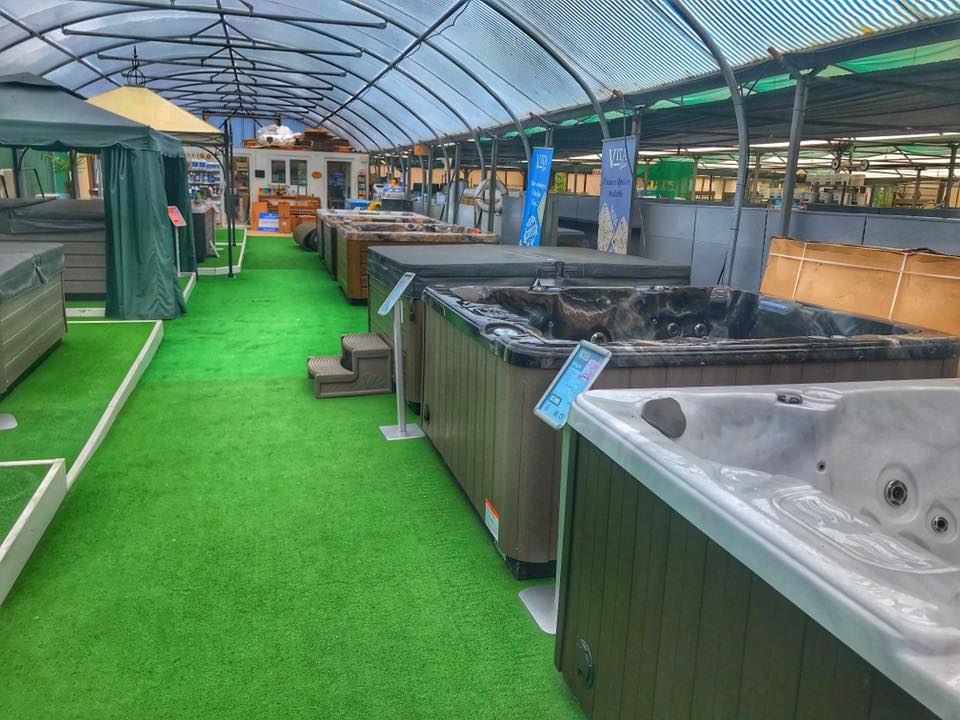
Do they have a showroom you can visit?
A website is not a showroom. Neither is a garden display at a garden centre with three tubs under a banner and no one to answer questions. A real showroom is a physical premises where you can walk in, see multiple models running, ask detailed questions, and have a proper conversation with someone who knows the products.
This matters more than it might seem. A showroom is a commitment. It requires a lease, staff, stock, and ongoing overheads. A dealer who has carried that for several years is telling you something about their stability and their confidence in what they sell. A dealer operating from a website and a van is a different kind of risk entirely.
Ask for the address. If the answer is vague, or the postcode leads to a residential street on Google Maps, take note.
Can you do a wet test?
A wet test is exactly what it sounds like: you get into a running hot tub before you buy it. You sit in the seats, feel the jets, check whether the depth suits you, and work out whether two people can actually fit comfortably or whether it is technically a four-seater in the way a hatchback is technically a five-seater.
Some dealers do not offer wet tests. Some say they do and then make it awkward or conditional. A dealer who is confident in their products will make it easy. A wet test costs them nothing except the time. If a dealer actively discourages it, ask yourself why.
Bring your swimming gear to any showroom visit. A good dealer will have towels.
How long have they been trading?
Hot tubs are a considered purchase. The business you buy from today is the business you are relying on for servicing, warranty support, and spare parts in year four. It matters that they will still be there.
Ask how long the company has been trading. Then ask for the company registration number and check it on Companies House. This takes two minutes and tells you the date the company was incorporated, any changes of director, and whether the accounts are being filed. A legitimate dealer will not mind you doing this.
Be cautious of businesses that appear to have been trading for one or two years, or that have changed their trading name recently. Some dealers have closed and reopened under new names. Companies House will show you the pattern if one exists.
Who are their manufacturers?
Hot tubs come from a relatively small number of manufacturers worldwide. The brand name on the side of the tub and the company name on the dealer’s website are often not the same thing, and that is fine. What matters is whether the dealer is an authorised dealer for the brands they sell, or whether they are buying stock from grey market sources.
An authorised dealer has a direct relationship with the manufacturer. That means the warranty is backed by the manufacturer, spare parts flow through an established chain, and if there is a dispute, you have a clear escalation path. Grey market stock is often cheaper. It is often cheaper for a reason.
Ask directly: are you an authorised dealer for this brand? Who is the manufacturer? Where are the tubs made? A confident dealer answers these without hesitation.
What does their after-sales support look like?
The sale is the easy part. What happens next is where dealers differ most.
Ask these questions specifically:
- If something goes wrong in year three, who do I call?
- Do you have your own service engineers, or do you subcontract?
- What is your average response time for a warranty callout?
- Do you stock common spare parts, or do you order them in?
- What happens if you go out of business? Is the warranty backed by the manufacturer?
The answers to these questions vary significantly between dealers. Some have a dedicated service team and stock a workshop full of spares. Others have a phone number that rings an engineer three counties away who orders parts from Europe on a six-week lead time. You want to know which one you are buying from before you sign anything.
Do they do their own installations?
Installation quality affects how your hot tub performs, how safe it is, and how much you end up spending on problems that could have been avoided. A well-installed tub, on the right base, with proper electrical work, should give you years of trouble-free use. A bad installation creates problems that are expensive and sometimes dangerous to unpick.
Ask whether the company installs with their own team or subcontracts. Subcontracting is not automatically bad. What matters is whether the dealer takes responsibility for the install regardless of who physically does it. If the answer is “the installation is between you and the installer, we just supply the tub,” that is a red flag.
Also ask what base they recommend. A good dealer will give you a specific, considered answer based on your garden and access. A vague “any firm, level surface” answer suggests they have not thought much about it.
Red flags to watch for
Some patterns appear repeatedly with dealers who cause problems later. None of them automatically means avoid, but each one warrants a sharper look.
- Heavy discounting. “Was £12,000, now £5,999.” Hot tubs do not get discounted by forty percent because a dealer is generous. Either the original price was invented, the current price reflects a margin problem, or the product is being cleared because something is wrong with it. Fixed, honest pricing is what a stable business does.
- Pressure to decide today. “This price is only available until Friday.” “We only have one left at this price.” Any version of this. A good dealer knows you are making a considered decision and gives you the time to make it.
- No physical premises. Already covered above, but worth repeating: if they cannot give you a real address where you can walk in, that is a significant risk.
- Will not let you speak to existing customers. Most dealers have happy customers who are willing to have a short conversation with a prospective buyer. If a dealer cannot or will not provide any references, ask why.
- Vague warranty terms. Ask to see the warranty document before you buy. Read it. Check what is covered, what is excluded, what the callout process is, and whether the warranty is with the dealer, the manufacturer, or a third party. If the warranty terms are hard to get hold of before purchase, that tells you something about how easy they will be to enforce after it.
Questions to take into the showroom
Here is a list you can print out or keep on your phone. A good dealer will have clear answers to all of them.
- Can I do a wet test in this model today?
- What is your company registration number?
- How long have you been an authorised dealer for this brand?
- Who manufactures this tub, and where?
- Do you have your own installation team, or do you subcontract?
- Who do I call if something goes wrong in three years?
- Do you have service engineers local to me?
- Can I see the warranty document before I decide?
- Can you put me in touch with a customer who bought from you in the last year?
- What is the installed price, including all electrical work and groundworks?
- What base do you recommend for my garden, and why?
- What does the running cost look like at current energy prices?
The honest bit: what we do well and what we do not
We sell VitaSpa and Reef Spas. We are authorised dealers for both. We do not stock every brand on the market, and we will not pretend that the brands we sell are objectively the best for every buyer. If your priorities point you elsewhere, we would rather tell you that than sell you the wrong tub.
We have a showroom in Hampshire that you can visit. We have been trading as PoolPro for twenty-five years. We use our own installation team. We have our own service engineers. We stock common spares. We do not do “was/now” pricing, we do not run manufactured sales events, and we do not offer commission-linked advice.
Finance is available through one provider. If another dealer offers terms that suit you better, that is a legitimate reason to consider them.
We are not the cheapest dealer in Hampshire. We have not tried to be. Our prices reflect a proper installation, a real warranty you can enforce, and a business that expects to still be here when you need a service call in four years.
We are also not the right choice if you want a brand we do not stock, if you need a very fast turnaround that does not fit our current lead times, or if a closer dealer would give you genuinely better service coverage. We would rather you knew that than found it out later.
One last thing
A good dealer will not mind you asking any of these questions. They will have clear answers ready, because they have answered them before. If a dealer becomes uncomfortable when you ask about their company number, their warranty terms, or whether you can speak to a previous customer, that discomfort is information.
You are spending a significant amount of money on something that will be in your garden for ten or fifteen years. The questions are the right questions. The dealer who welcomes them is more likely to be the right one.
If you want to come and ask them of us, our showroom details are on the contact page. Bring your swimming gear.