

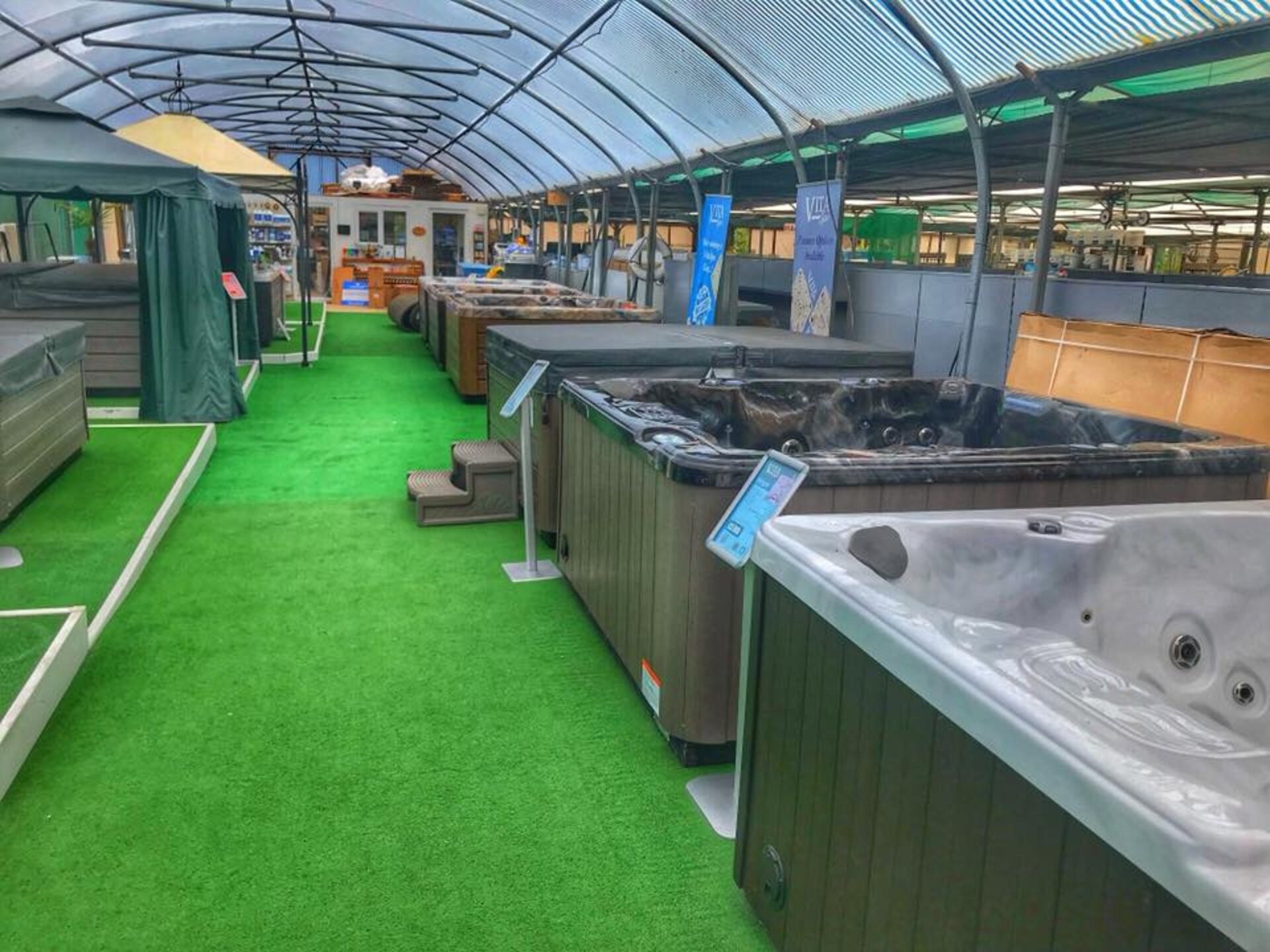
Most people who come into the showroom have already decided they want a 6 or 7-seater. They’ve been researching online, reading about jets and insulation, and somewhere along the way a 7-seater became the obvious choice. More seats means more tub. More tub means better value. Seems logical.
Graham and Mark spend most of their time gently unpicking that assumption. Not to sell a smaller tub (though that often happens). But because buying the wrong size is one of the few decisions in this purchase that’s genuinely hard to reverse.
This is the showroom conversation written down.
Start with one question
Who is actually going to be in this tub, ninety per cent of the time?
Not who might use it. Not who you’d like to have round. Who is actually, realistically, going to be in it on a Tuesday evening in February?
For most buyers, the honest answer is: us two. A couple, after work, a few nights a week.
That changes the calculation significantly.
Why people buy too big
A 7-seater sounds like a great idea in the showroom. You imagine summer evenings, a group of friends, the kids home from uni. That image is real and it will happen. But it might happen eight or ten times a year. The other two hundred and fifty times, it’s you and one other person.
A 7-seater hot tub holds roughly 1,500 to 2,000 litres of water. You heat all of it, every time. You balance the chemistry across all of it. You maintain it for all of it. And two of you sit in opposite corners of a tub built for seven.
Running costs are broadly proportional to water volume and heat loss. A well-insulated 4-seater will cost less to run per month than a well-insulated 7-seater from the same manufacturer. Not dramatically less in all cases, but meaningfully less over a year, and that difference compounds over the life of the tub.
We are not saying don’t buy the 7-seater. We are saying: be honest about who is going to use it.
The weight question is real
Before you think about seating, think about what you’re putting in the garden.
A typical 6-seater hot tub weighs around 300 to 400 kg empty. Filled with water, you’re looking at 1.5 to 2 tonnes. That needs to sit on something solid. A standard timber deck is usually not enough without structural reinforcement. A concrete base or a properly spec’d composite deck is the normal answer.
Smaller tubs are lighter. A 4-seater filled might come in under a tonne. If you have a raised deck or restricted access, this matters more than almost anything else.
Access also matters for installation and maintenance. Hot tubs need a gap around them, typically 600mm minimum on at least two sides, for the engineers to get to the equipment bay. A tight garden, a narrow gate, a stepped path: these are all things to talk through before you commit to a size. We survey the site before installation, so nothing comes as a surprise on the day.
The seat design question
Bigger tubs don’t just have more seats. They often have different seat designs to the smaller models in the same range, and this affects how the tub actually feels to use.
There are two main seat types. Deep bucket seats and arms-out seats.
Deep bucket seats
You sink in. Your shoulders are at or near the waterline. The jets hit your back, shoulders and neck at close range. Good for hydrotherapy, therapy for specific areas, or just sitting and not moving for twenty minutes. Less good if you want to move around or change position.
Arms-out seats
A shallower, wider seat. You sit upright, arms along the edge or in the water. More of a social position. You can rotate, stretch, face a different direction. Good for conversation, for kids, for people who don’t want to feel locked in.
Many tubs mix both. A well-specified 5-seater might have two deep therapy seats, two arms-out seats, and a footwell area. That gives you variety without needing seven seats.
If you have a specific physical reason for buying a hot tub (back pain, hip issues, post-surgery recovery), lean toward a tub with at least two quality bucket seats with targeted jets, regardless of total seat count. The seat position matters more than the number.
A rough guide by size
2-seater
Compact. Genuinely only for couples who know that’s what they want. Installation is straightforward, running costs are low, and some models are surprisingly well-specified for the footprint. If you have a small courtyard or a tight garden and you’re a couple, this is worth looking at seriously rather than dismissing. Not many people end up here, but those who do are usually very happy.
4-seater
Probably suits more buyers than any other size. A couple with two kids, or a couple who will occasionally have another couple over. Fits most average gardens without drama. Enough jet variety to give you real choice of seating position. Lighter than larger models, easier to base, and in a good insulated range, the running costs are genuinely manageable.
5-seater
A step up in footprint without the full water volume of a 6 or 7-seater. Suits a family of four or five, or a couple who entertain regularly. Often a good middle ground if you are torn between 4 and 6.
6-seater
The most popular size for a reason. Families with teenagers, couples who regularly have friends round, anyone who wants space without committing to the largest footprint. You are now looking at a substantial install: base requirements, electrical supply (typically 32A dedicated circuit), and a tub that will be in the garden for ten to fifteen years. Plan the space properly.
7-seater and above
For buyers who genuinely entertain in numbers, have a large family who all want to be in at once, or are buying for a rental property or shared space. Not wrong. Just specific. If you are buying a 7-seater because it sounds like better value, that logic usually doesn’t hold once you’ve run it for a winter.
The honest conversation we have in the showroom
We will point you to a smaller tub if it fits better. Every time. We would rather sell you the right one than the big one.
A 4-seater that you use three times a week is a better purchase than a 7-seater that sits empty most of the time and costs more to run. We see it happen the other way round too: someone undersizes and regrets it within a year. The goal is the right tub for how you actually live, not the tub that looks most impressive in the brochure.
This is genuinely how the team work. If you come in set on a 7-seater and leave with a 5-seater, that’s a good outcome for everyone. If you come in unsure and leave with the 7-seater because it turns out you host regularly and your adult kids are home every other weekend, that’s also a good outcome.
Practical notes before you visit
A few things worth thinking through before you come in or get in touch:
- Who uses it most: Be honest about the day-to-day, not the best-case.
- Garden access: Measure the narrowest gate or path between the road and your intended spot. Some deliveries need 900mm minimum clearance. We check this before delivery, but it helps to know upfront.
- The base: Tell us what you have. Concrete, existing patio, decking, bare ground. We’ll tell you what’s needed.
- Electrics: Most hot tubs over about 3kW need a dedicated circuit with an RCD. Your electrician handles this, not us, but we’ll tell you the spec you need.
- Budget for the full picture: The tub price, the base (if you need one), the electrician, and the ongoing chemicals and energy. None of these are hidden, but buyers who only budget for the tub occasionally get a surprise.
What to do next
The honest answer is: come and sit in a few. The showroom has wet tubs you can get into, which sounds obvious but most dealers don’t offer it. The difference between a deep bucket seat and an arms-out seat is something you feel, not something a spec sheet can explain.
If you’re not ready to visit yet, the next useful thing is to decide honestly on the primary use case. Couple most of the time. Family regularly. Entertaining frequently. That single answer narrows the range considerably, and we can point you to the right shortlist from there.
There is no right answer that works for everyone. There is a right answer for how you live. That’s what we’re trying to find.