

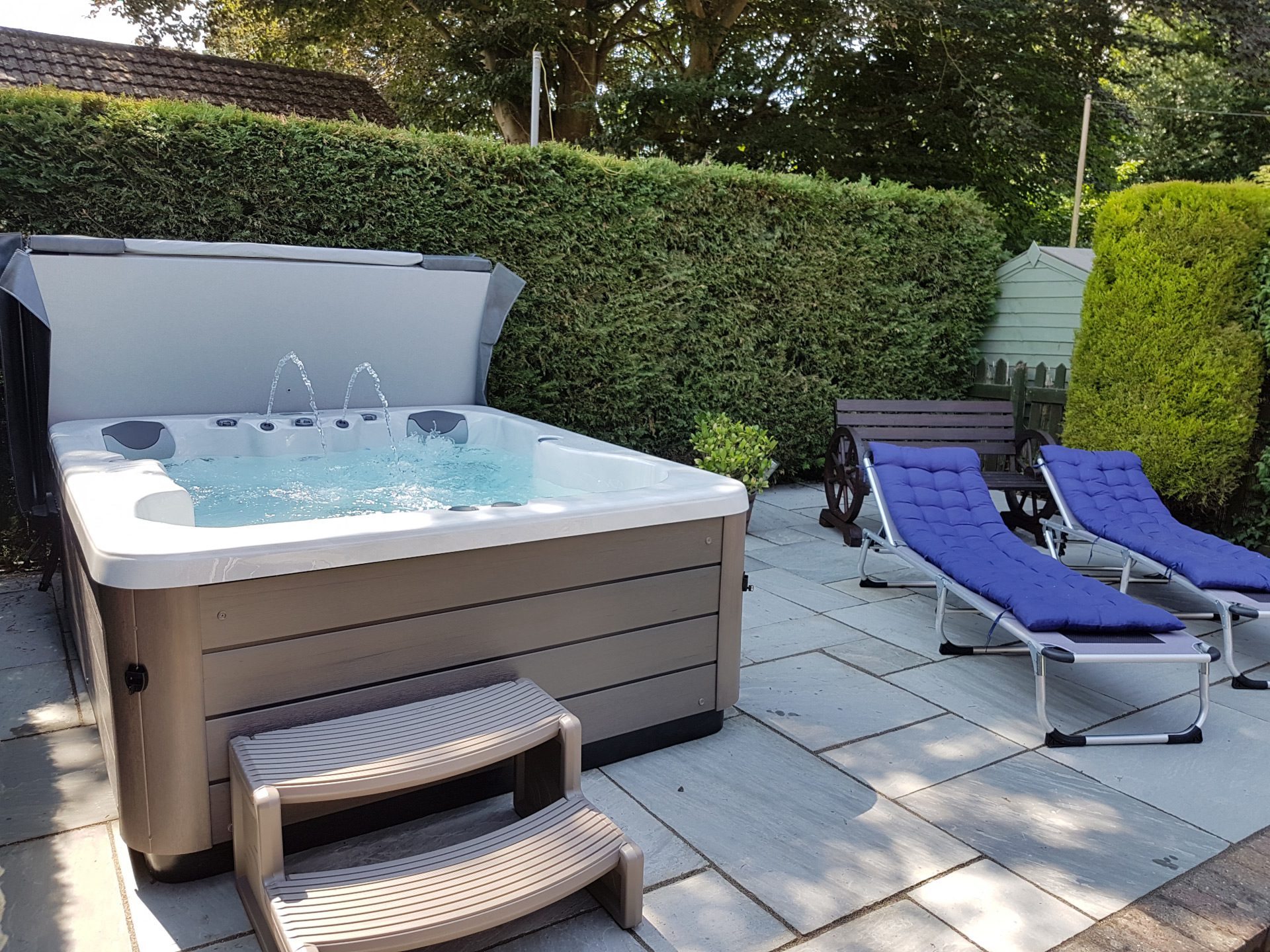
The first conversation most people have with us about a hot tub is about the tub itself: which model, how many seats, how many jets. That is fine. But the second conversation, which we try to have quite quickly, is about where it goes. Get that wrong and you can end up with a cracked base, a very expensive crane hire, or a tub you never actually use because it is too far from the back door in February.
This guide covers what we look at before every installation, and what you need to know before you commit to a position in your garden.
The site survey: what we look at and why
Alex does our installations. Before any tub goes in, he visits the site. It usually takes about twenty minutes, and it saves everyone from nasty surprises later.
He is looking at several things at once: the access route from the road or driveway into the garden, the proposed position and what the ground is doing there, the proximity to your electrical supply, and anything that will complicate the job. A steep slope. An overhead cable. A narrow passage with a gate post right where you need to swing a corner. These things do not stop us, but they do affect the plan and sometimes the cost.
We do the survey before you commit to a final position. That is the whole point. If you have a rough idea of where you want the tub, great. If you have no idea, that is equally fine. Alex will walk the garden with you and give you an honest view of which spots work well and which will cause you problems down the line.
You do not have to know exactly where the tub is going before you contact us. That is partly what the site survey is for. Come in, pick a tub you like, and we will work out the rest together.
Getting the weight right: a filled tub is very heavy
This surprises people more than anything else we tell them. A mid-size hot tub weighs around 300 to 400kg empty. Fill it with water and add four people, and you can easily be looking at 1,800 to 2,200kg sitting in one place in your garden. That is roughly the weight of two family cars, concentrated on whatever surface is underneath.
Your patio paving might look solid. It often is not, at least not solid enough for that kind of load over a small area. This is why the base matters, and why we do not cut corners on it.
Base options
Concrete pad (most common)
A reinforced concrete pad is the standard recommendation. For most installations, Alex will specify a 100mm slab with a steel mesh reinforcement, sitting on a well-compacted sub-base. Done properly, this will last the life of the tub and give you nothing to worry about. It costs more than the alternatives, but it is the one we recommend most often because it is the one that causes the fewest problems over ten or fifteen years.
The pad should be slightly larger than the tub’s footprint on all sides, and it needs to be level. Not approximately level. Level.
Reinforced deck
Decking is popular, and it can absolutely work, but the standard garden decking you already have almost certainly cannot take the weight. If you want to put a tub on a deck, the deck needs to be engineered for the purpose. That means heavier joists, closer spacing, and proper structural supports underneath. A good decking contractor can build this. We can advise on the spec.
One advantage of a deck install is aesthetics: the tub sits flush or near-flush with the deck surface, and the area underneath can be used to run cables and pipework neatly. One disadvantage is that access panels on the tub must remain accessible, so the decking cannot be fully enclosed around the base.
Paving slabs
Existing paved areas sometimes work, sometimes do not. Loose-laid slabs on a sand bed will shift under load over time. Fully-mortared slabs on a solid base can be fine if the sub-base is adequate. Alex will check this during the survey. The honest answer is that existing paving is always a question mark until someone who knows what they are looking at has stood on it and thought about it.
Hot tub pads
Interlocking plastic or composite pads are marketed as a quick base solution. They work reasonably well as a temporary measure or on a very firm, already-level surface. We do not discourage them outright, but we would not specify them for a permanent installation where the ground has any softness or movement in it. For most customers buying a tub at this level, a proper concrete pad is a better long-term investment.
Access: getting the tub in
Hot tubs are big and they are heavy. Most manufacturers build them so they can be tilted onto one edge and rolled or slid through a standard double gate. That means you need a gate opening of roughly 900mm clear, a hard enough surface to roll on, and enough room to manoeuvre corners.
Where it gets complicated is narrow side passages, steps, raised gardens, and properties where the only route to the back garden involves going through the house. Alex has seen all of these, and most of them have a solution. We have a tipping trolley and various handling equipment that makes tight spaces more manageable than they look.
Where there is genuinely no ground-level route, we hire a crane.
The Treetops installation
A few years ago we installed a tub at a property we call Treetops, not because that is its actual name but because of where the tub ended up. The garden was steeply terraced, the access from the road was across the neighbours’ land (with permission, but still), and there was no way to get a tub the size the customers had chosen down the slope by hand without risking injury or damage to the tub.
We hired a crane. The tub was lifted over the roofline and lowered onto the prepared pad on the lower terrace. The customers were there to watch. Alex was very calm about the whole thing. The tub has been running without a problem since.
We mention this not to put the cost in your head, but to let you know that “there is no way to get it in” is almost never actually true. It just sometimes means a different plan.
Distance from the house
Put the tub close enough to the house that you will actually use it. This sounds obvious but is one of the most common mistakes we see.
A tub at the far end of a long garden looks good in a planning sketch. In practice, in November, walking forty metres across wet grass in your dressing gown at 9pm is not something most people do for long. The tub gets used less. Eventually it becomes an expensive feature of the garden you occasionally look at from the kitchen window.
In general, within about six to ten metres of the back door is a good target. Closer is fine. Further can work if the garden design genuinely requires it and the path is lit and level, but go in with eyes open.
Distance from the house also affects your electrical run. The further the tub, the longer the cable, the higher the material cost of the install. It is not usually a deal-breaker, but it adds up.
Electrical supply
A 13-amp plug-and-play tub needs no special electrical work. You plug it in to a standard outdoor socket and you are done. The trade-off is lower power, slower heating, and less jet performance.
Most tubs we install run on a 32-amp dedicated circuit from the consumer unit. This is a proper electrical job that needs a qualified electrician and a building regulations notification. Alex coordinates this. We have electricians we work with regularly, and it is not a complicated or unusual job; it just needs to be done properly.
We are writing a dedicated guide to hot tub electrics, which will cover the full detail. For now: assume a 32-amp circuit, budget for the cable run from your consumer unit to the tub position, and factor that distance into where you place the tub.
Drainage
Hot tubs need draining periodically, typically every three to four months depending on usage. A tub holding 1,200 to 1,500 litres of water needs somewhere for that water to go.
The best option is a nearby surface drain or soakaway. Many garden positions have neither, in which case you drain via a submersible pump into a long hose run to the nearest suitable point, often a drain at the side of the house. This is perfectly workable; it just takes slightly longer and benefits from planning rather than discovering the problem on the night you first need to drain.
Do not drain a hot tub onto a neighbour’s garden, into a ditch without checking the rules, or in large volumes directly onto a lawn (the dechlorinating chemicals are fine in small concentrations, but a full drain onto one area can damage grass).
Privacy and shelter
You are going to be sitting in warm water, probably at night, in your garden. Think about the sightlines before you commit to a position.
The obvious issues are overlooking windows from your own house or neighbours’ houses, and any raised positions nearby like footpaths or terraces. A slightly different position in the garden can completely change the privacy picture. Screening does not have to be expensive: a well-placed planting border, a timber screen panel, or existing mature shrubs can be enough.
Shelter from wind is less about modesty and more about comfort. A tub in a fully exposed position will lose heat faster and the surround will feel cold on cold evenings. A degree of natural shelter from walls, fencing, or planting is worth seeking out. It also means the tub is quieter, which matters if neighbours are close.
Common mistakes
- Too close to trees. Deciduous trees mean leaves in the water and blocked filters, repeatedly, for several months of the year. Roots under a concrete pad can cause cracking over time. A gap of at least three to four metres from any large tree is sensible.
- Too far from the house. Covered above. If you will not use it in winter, you have spent money on something that earns its keep for four months a year.
- Inadequate base. The most expensive mistake. A base that fails under load can damage the tub’s cabinet, create a tilt that stresses the plumbing, and in the worst cases crack the shell. It is a false economy to underspec the groundwork.
- Blocking access for servicing. The tub has access panels on its sides for a reason. If you fully enclose the surround or build decking in a way that seals those panels off, a routine service becomes a major job.
Let us come and look first
Every installation we do starts with a site visit. We do not charge for it. Alex will look at your garden, give you an honest view of what works and what needs thinking about, and flag anything that might affect the plan before it costs anyone money.
If you are seriously thinking about a hot tub, this is the right first step before you settle on a position or start any groundwork. Get in touch and we will book it in.