

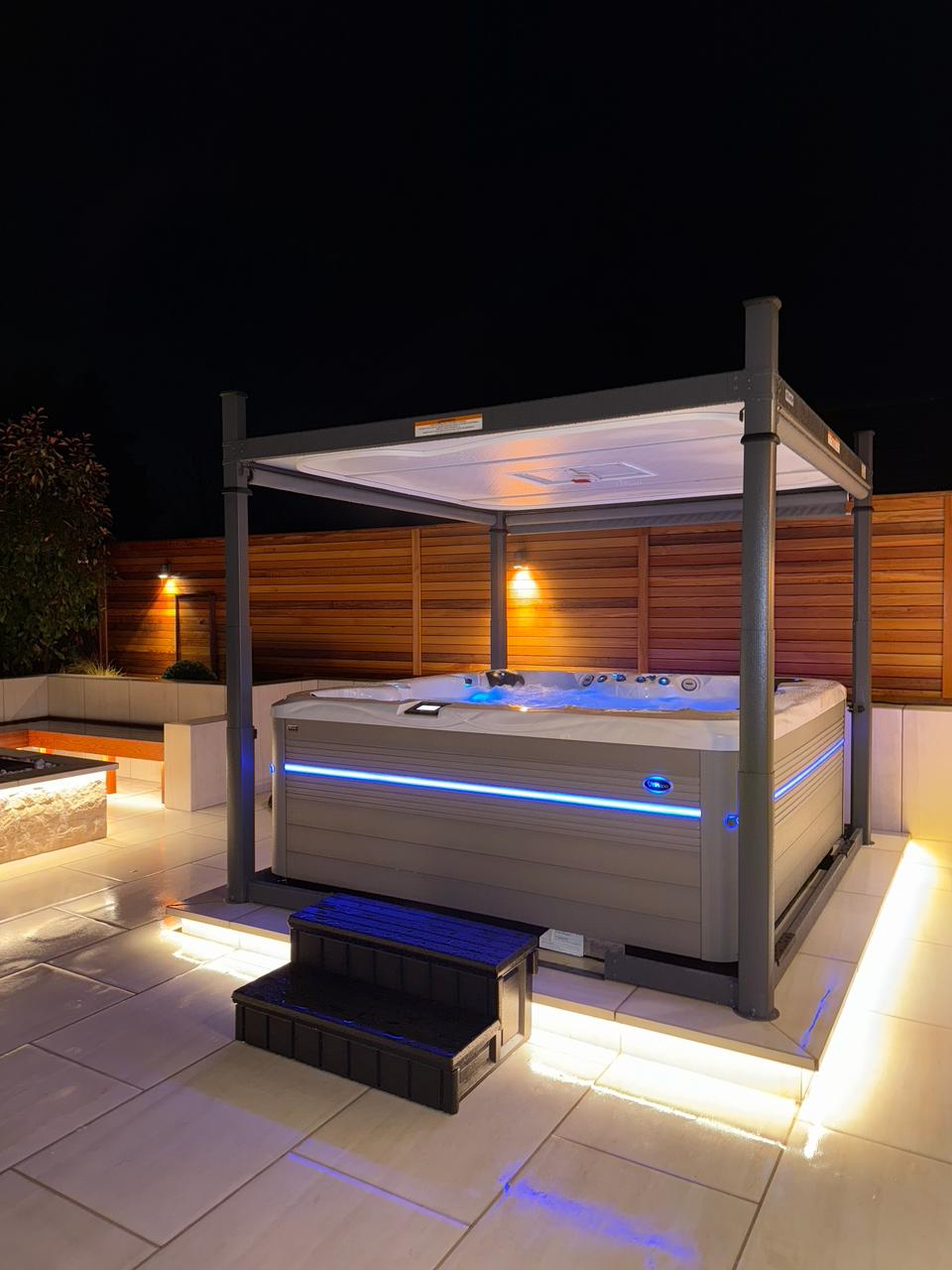
Most people buy a hot tub in spring or summer, when the evenings are warm and the garden already looks good. Then October arrives and something changes. The lid comes off more, not less. The cold air and the hot water together are better than either would be on its own, and once you have experienced that contrast properly, a warm summer dip starts to feel a bit flat by comparison.
Winter is not the obstacle to hot tub ownership. For most owners, it turns out to be the best part.
How modern tubs handle freezing temperatures
A well-built hot tub will protect itself in cold weather without you doing much at all. The mechanisms are straightforward: the circulation pump runs at low speed continuously, keeping water moving through the plumbing. Moving water does not freeze at normal UK winter temperatures. The heater tops up heat gradually rather than working in long cycles, so it maintains temperature efficiently rather than fighting to recover from a drop.
Good insulation is what makes this work well. A full-foam tub like the VitaSpa range fills the cabinet completely with high-density foam. That means heat generated by the pump motor and heater stays inside the cabinet. Less heat escapes, so the heater works less. The running costs in February in a well-insulated tub are genuinely lower than many owners expect.
Poorly insulated tubs, typically those with a thin layer of foil and a lot of empty air space in the cabinet, struggle much more in winter. The heater runs longer and harder. If you are buying with winter use in mind, ask specifically about insulation specification. It is one of the questions worth asking in the showroom.
What it actually costs in winter
Honest answer: more than summer. The tub is fighting a bigger temperature differential between the water and the air. A well-insulated 5-seater running at 38 degrees will typically cost between £30 and £50 per month in electricity over winter at current UK rates, depending on your tariff and how often you use it. A poorly insulated tub in the same conditions can cost considerably more.
Two things reduce winter running costs significantly. First, keep the cover on whenever the tub is not in use. Heat loss through an uncovered surface in cold air is substantial. Second, if you use the tub regularly, keeping it at temperature is cheaper than heating it from cold each time. Dropping the setpoint to 35 degrees when you know you will use it that evening, then raising it back, saves a small amount but adds friction. Most owners find it easier to leave it at temperature year-round.
A decent insulated cover is a meaningful part of the system, not an accessory. We cover this in more detail in our guide to covers and energy saving.
Getting in and out in cold weather
The practical side of winter hot tubbing takes about a week to figure out and then becomes habit.
- Keep a large towel and a robe somewhere dry and close to the door. The ten-second walk back to the house in January is cold enough that you will notice if you have not prepared for it.
- Slip-resistant steps matter more in winter. Ice can form on decking around the tub. Non-slip surfaces or a small mat near the steps are worth having.
- Chemical balance still needs maintaining weekly. Cold weather does not pause the chemistry.
- A mug of something warm on the tub surround is optional but, in our experience, universally adopted by week three.
One practical rule that applies all winter: keep the lid on whenever the tub is not in use. Even for twenty minutes. Heat loss through an open surface in cold air is fast. It costs you money and costs the heater effort. The lid is doing real work in January.
Snow and ice: what to do (and what not to worry about)
Snow on the cover is fine. It is actually a reasonable extra insulator. Brush it off if it becomes heavy, because the weight over time can compress the foam core and reduce the cover’s effectiveness. A gentle sweep with a soft brush is enough. Do not use a shovel or anything sharp.
Ice forming on the cover surface is normal and nothing to worry about. Ice around the tub base or on nearby decking is worth watching for safety reasons when you are getting in and out, but it does not affect the tub’s operation.
The one scenario to avoid is a water spout or water feature running in freezing conditions. If your tub has decorative water features, turn them off in hard frost. Exposed water in the air can freeze before it returns to the tub. The jets and internal plumbing, which are submerged or protected in the cabinet, are fine.
Going on holiday in winter
This is the question we get more than any other when the temperature drops: what do I do with the hot tub if we are away for two weeks at Christmas?
Leave it running. That is the whole answer.
Do not drain it and leave it empty. An empty hot tub in a freeze will suffer cracked plumbing, damaged pump seals, and in some cases a cracked shell. These are expensive repairs. A running hot tub in an empty house is drawing a small amount of electricity, maintaining circulation, and protecting itself. That is what it is designed to do.
Before you leave: check and balance the water chemistry, make sure the cover is properly latched, and set the temperature to at least 35 degrees. Most tubs can be left unattended for two weeks without any issues at all. If you have a neighbour who would walk past occasionally, that is peace of mind, but it is not a requirement.
Some owners drop the temperature to 30 degrees when away to save a small amount of running cost. That is fine as long as you keep it running and maintain that minimum. Do not turn the heater off entirely.
Why the cover matters more in winter
A hot tub cover is not just a lid. It is the primary insulation barrier between your heated water and the outside air. In summer that matters. In winter it matters much more.
A good cover has a high-density foam core (typically 4-inch taper from 4 to 2 inches), a vapour barrier inside the foam to prevent water absorption, and a secure underside seal that sits flush against the tub cabinet. Over time, covers absorb water through small cracks and around the stitching. A waterlogged cover can weigh 60kg or more and insulates poorly. If your cover feels heavy when you lift it, it has probably absorbed water and needs replacing.
We recommend checking your cover’s weight and condition at the start of each winter. A replacement cover typically costs between £200 and £400 depending on the tub size and specification. Against the running costs of a poorly insulated cover across a winter, the replacement usually pays for itself.
Some owners add a floating thermal blanket beneath the cover as a secondary layer. These are inexpensive and do reduce heat loss and chemical evaporation. They are not essential but worth considering if you want to reduce running costs further.
The honest case for winter use
We have sold hot tubs for a long time. The owners who get the most from their tubs are, almost without exception, the ones who use them through winter rather than treating October as the end of the season.
There is something about getting into 38 degree water when it is 2 degrees outside. The cold air on your face and the heat on everything else. It does not wear off. Owners who have had tubs for five or six years still describe it as one of the better parts of their week.
If you have been putting off buying because of winter, that is probably the wrong way round. Winter is the argument for buying, not against it.
If you have questions about winter running costs, insulation specifications, or what to do before you go away, come and talk to us in the showroom. We can walk through the specific tub you are looking at and give you realistic numbers for your setup. No pressure, no sales script. Just a straight conversation.